Most Recent Posts
- The Last Retreat
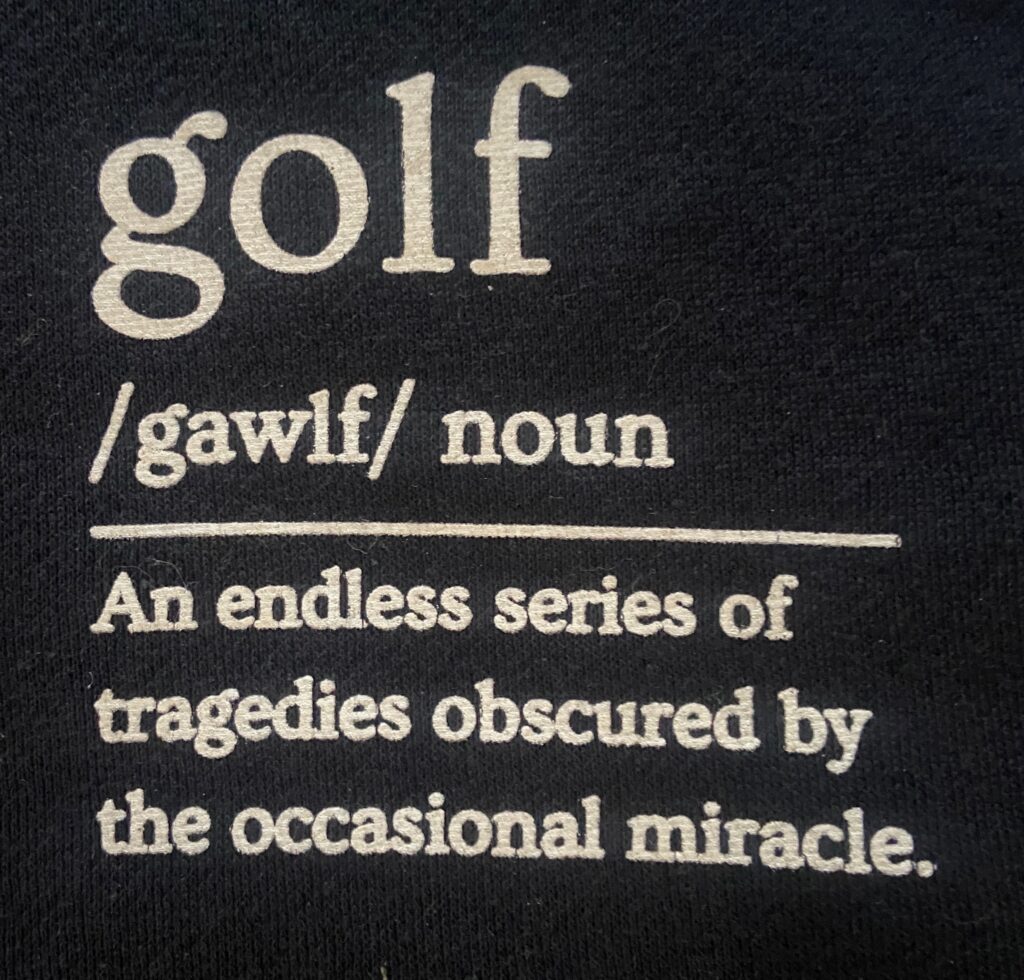
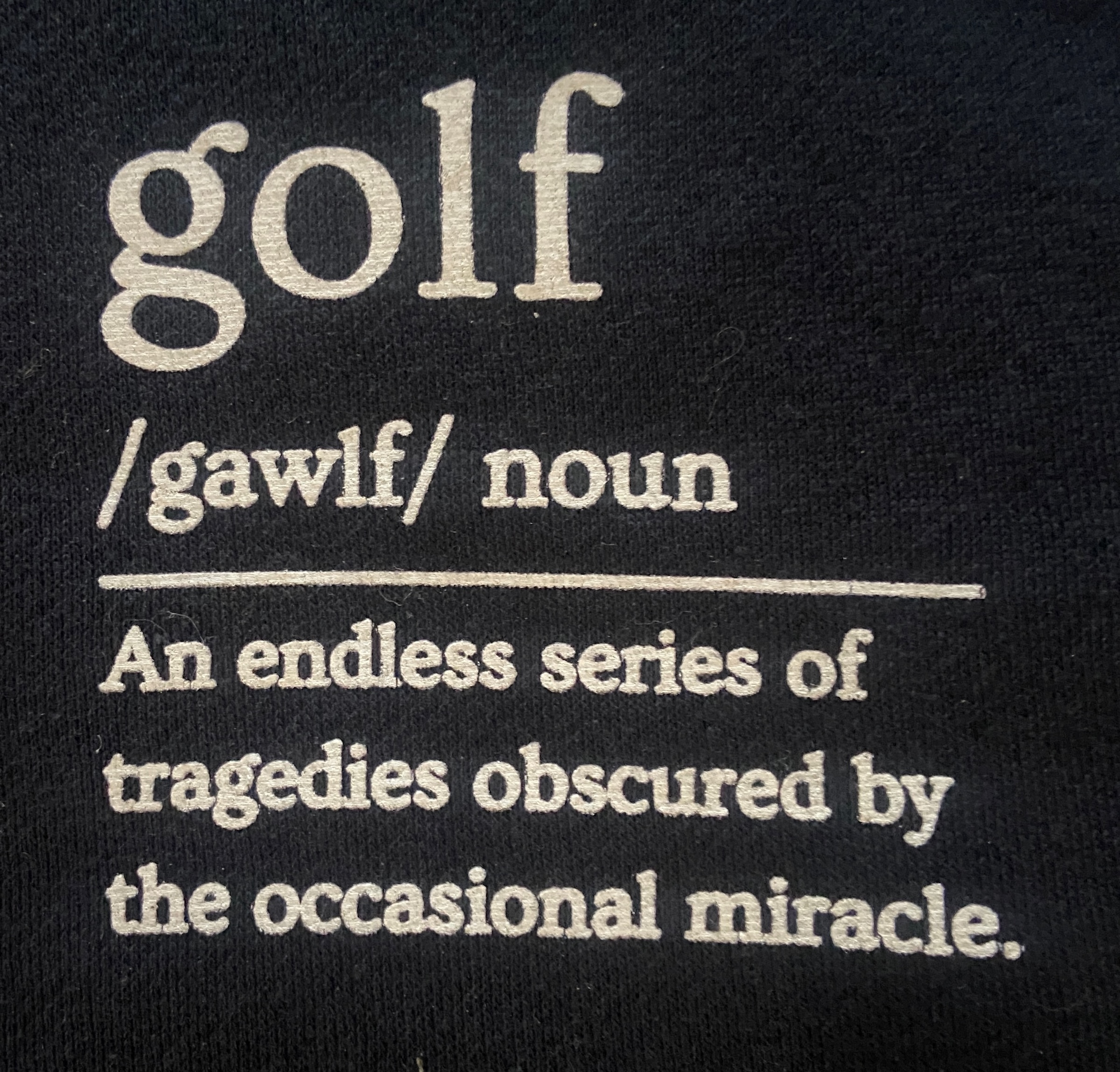
A year or so ago for one of those giving times, my daughter Blythe gave me a sweatshirt. It is nice and comfortable. i wear it a lot.
The sweatshirt graphics also perfectly describe my golf game. i would add the tragedies are nearly always accompanied by a yell from a sailor’s vocabulary, i.e. profanity. i have tried to stop, but hey, i’m on a golf course with a bunch of guys, and i am only commenting on my talent, or lack thereof.
i have never been a really good golfer. i learned at the Hunter’s Point Golf Course, now defunct, and foolishly bought equipment with money i didn’t have, which also impacted my reluctance to take a lesson until much later in my life. As i have told several really good golfers with whom i have played, i am the golfer with one thousand swings and only about three of them are “good swings.” i was somewhat gratified when i saw the great Tony Gwynn, one of my all time baseball heroes for many reasons in a video of his swing: Lord a’mercy, it looked like mine.
But i have played the game since those first rounds on Hunter’s Point Pike with Henry Harding, Charles “Fox’ Dedman, and Jimmy Nokes. i have played in Hawaii, Japan, the Philippines, Palma de Majorca, Korea, Guam, and if XOing hadn’t interfered, i would have played in Mombassa, Kenya. i’ve played on Christmas Eve, Thanksgiving, Black Friday, and goodness knows how many other holidays.
To cover all of the times and places i’ve played golf would be and endless post.
Then, in the summer of 1985, i went for a lunch run on Coronado. i ran to the bridge entrance and turned back as usual on this six-mile jaunt. There on the sixth tee were two fellow officers at the Naval Amphibious School. The next day, i asked them if i could join them in some rounds.
i then began playing with Rod Stark and Marty Linville every Saturday at either Admiral Baker North, Miramar, then a Naval Air Station, and Sea ‘n Air, the course on North Island’s Naval Air Station. Several folks would round out our foursome with the most frequent being my father-in-law, Ray Boggs. Ray became a friend to Rod and Marty and created a plethora of great stories.
Then we retired: Marty first, i second, Rod third. “Retired” is not a good term for what we did. The real description of what we did was “complete our military service:” Marty Army, Rod and i Navy. One who completes his military service after twenty-plus years as a major or commander cannot live alone on his (or her for the politically correct) retirement. So, we all sought other jobs. Marty worked for a tech company that improved the human/weapons interface. Rod became a golf pro in Sun City, California, commuting each day from San Diego. i became mister mom (Sarah was born the day i retired for those who might not know).
Then on a Saturday in May 1991, i believe it was May 11, Marty and i were playing a round at Sea ‘n Air. After the round, Marty noted his work schedule had just changed to 4x10s, that is, he was working ten hours four days a week and his Fridays were free. He wondered if i could play on Fridays. Being mister mom and Sarah had started day care, i figured i could.
The next Friday, May 17, 1991, we began playing every Friday. We added Ray frequently. In 1995, we saw Rod on the Miramar course and found out he had left his job to tend to his wife Donna. He joined us in our Friday rounds.
Over the years, i introduced close friends with whom i also played golf to the group: Al Pavich, Jim Hileman, JD Waits, Pete Toennies, and Pete Thomas, my brother-in-law Danny Boggs, and cousin Lance Cook. Then we added my neighbors: Keith Macumber, Spud Mumby, Ralph Lavage, and Randy Prescott. For a while in the late 90s, we had as many as four foursomes playing.
Over half of those listed above have crossed that rainbow bridge including the co-founder of the Friday rounds, Marty. A number can no longer play due to infirmities, the scourge of aging.
Pete Toennies asked a couple of his Navy SEAL buddies to join us. Now we have five seals and about four friends of ours who join us. We usually have two foursomes. About three years ago, we moved our Friday Morning Golf to Thursday Morning Golf. MWR began charging weekend fees for Friday and tournaments often made getting Friday tee times difficult.
My golf also included other rounds with friends. The telephone group i joined because of Jim Hileman was wonderful.
Golf with Maureen, most often with Pete and Nancy Toennies remains a delight.
Of course with age, my already not so hot golf has gotten worse as is the case for most of us.
So why do i keep playing?
It’s golf. i’m walking well over five miles each round. But more than that, it’s respect for the game and the camaraderie that exists with these guys. The nineteenth hole has become as important as the game. We catch up. We tell stories, most often retelling them. We toast to Marty before our first beer.
My favorite past time has always been, since Lebanon Junior High School, 1956-58, football. It turned out i was never going to be a prime time running back. i discovered my true joy in football was tackling someone, even in practice…and i did a lot of that. But it stopped when i graduated from Castle Heights in 1962. i still miss it.
i always loved basketball. Although i had a decent shot, was a good defender, and decent point guard, height and probably some other missing capabilities such as dribbling and shooting with only my right hand, my formal basketball ended with the JV team at Heights. i did continue with pickup games into my late thirties.
Baseball was next to football in my love of sports. i played from Pony League for nine-year olds in 1953 until i hung up my spikes in the over-33 baseball league in the Southwest corner when i was 46.
Around 1976, i began running. i continued to run until my mid-70s when the doctor and my old body told me to stop. Now, i walk when my body tells me it’s okay, which is not often enough.
The only thing left is golf. It’s my retreat. Although my game stinks, it is the last vestige of sport in which i can participate. Golf is good that way. i’ve always preferred to play sports rather than attend them even when i was a sports writer and editor. Golf is now my lone retreat.
At 82, i will be teeing it up tomorrow. Thanks to all of my buddies for letting me join them in the past and now. And Marty, Al, Harvey, Frank, and Ray, i will toast to all of you as well as the many others i have enjoyed in this retreat.
- Everett’s Second Law of Thermodynamics
Confusion is always increasing in society. Only if someone works extremely hard can this confusion be reduced in a limited region. Nevertheless, this effort will still result in an increase in the total confusion of society at large.
When i first read this in 1979/80, i wasn’t sure what it meant. Today in our current society, i know exactly what it means. Yep, we are confused, big time.
- Boaz and the River Jordan
i drew from several sources when this came into my head, i am not a biblical scholar. Although there are some things included from the Bible and gospels, i made this up, fiction. It was something that just seemed to fit.
Boaz walked down to the River Jordan;
the current was strong;
the waters were deep;
there was no bridge;
there was no ford;
he could not cross;
Boaz waited for a fortnight;
the waters of River Jordan would not subside;
the currents ran strong;
the depth was too much;
he could not cross;
he could not cross to the other side.Boaz waited another day,
then walked west to the Mediterranean,
boarded a Ship of Tarshish
to ride the seas westward
while learning trading for gold and silver.Sailing the seas, Boaz became rich:
viewed by folks of the time
as wise, just, and benificent;
he sailed the seas he had come to love
for his remaining days.and
the River Jordan flowed on and on
with strong currents and an unfathomable depth. - Deja Vu, sort of, All Over Again
Last night, i received a text from one of my favorite people.
Katherine Jewell Hansen, with the same middle name as me, Rye — we both got if from her grandfather and my father — is an incredible woman. She is my brother’s daughter, a Vanderbilt alum like her husband, her father, and in a weird sort of way, me.
Kate is a professor of history at Fitchburg State University in Massachusetts and has written two dynamite books.
Dollars for Dixie is a intriguing non-fiction about the industrialization in the South that draws upon the success of the Lebanon (Tennessee) Woolen Mills and is an in-depth analysis of how the South evolved in industrialization.
Live from the Underground is a wonderful exploration of the history of college radio and has become a beacon for a superb medium.
Well, her text was:
Navy question: why are they getting the space people out with helicopter rescue guys to take them to the carrier? Why not a boat? What range of landing zone would they be working with?
Kate was with friends of hers watching the Artemis II splashdown. Since she knew i had been on ships in the Navy, i was pleased she reached out to me.
My response:
A helicopter would be much safer, faster, and easier than a boat recovery. The landing zone would have been a circle with about a 10-mile radius from the center. It was projected to be about 50-70 miles from the San Diego coast. Apparently, the USS John P. Murtha (LPD 26) was the lone recovery ship. i believe it would have been outside the projected splashdown area for safety reasons. That makes a helicopter recovery of the astronauts even more practical than a boat.
i don’t know if you know this, but in 1969, My ship, the USS Hawkins (DD 873) was the Atlantic recovery ship for Apollo 12. The USS Hornet (CVS 12) was the primary recovery ship in the Pacific.
Right after blastoff the spacecraft was hit by lightning causing loss of fuel cells and electrical instrumentation. The decision was to take one more orbit around earth. If no solution was found during the orbit, the spacecraft would make an emergency splashdown in the Atlantic. Hawkins would make the recovery.
We had our deck strengthened and a crane added to our fantail in the Portsmouth (VA) Naval Shipyard. We went to Bermuda where we practiced recoveries of a dummy capsule and then went to our station about midway between Bermuda and the Azores.
i was the recovery Officer of the Deck and would have had the conn (maneuvering control) to bring the ship alongside the capsule to raise it to our fantail. Fortunately, a flight controller in Houston, John Aaron, had the astronauts switch to “auxiliary,” and the flight continued on a successful mission and returned to the Pacific and the Hornet.
Had it landed in the Atlantic, my life would have changed dramatically. As it was, we had a very nice week in Bermuda, one of my favorite places on earth.
i, in my usual fashion, began to think about that time. i, even though i didn’t know it, was in a wonderful spot, in something that turned out to be one of my true loves. It was a nice memory.
Thanks, Kate.
- Ballance’s Law
How long a minute is depends on which side of the bathroom door you’re on.